
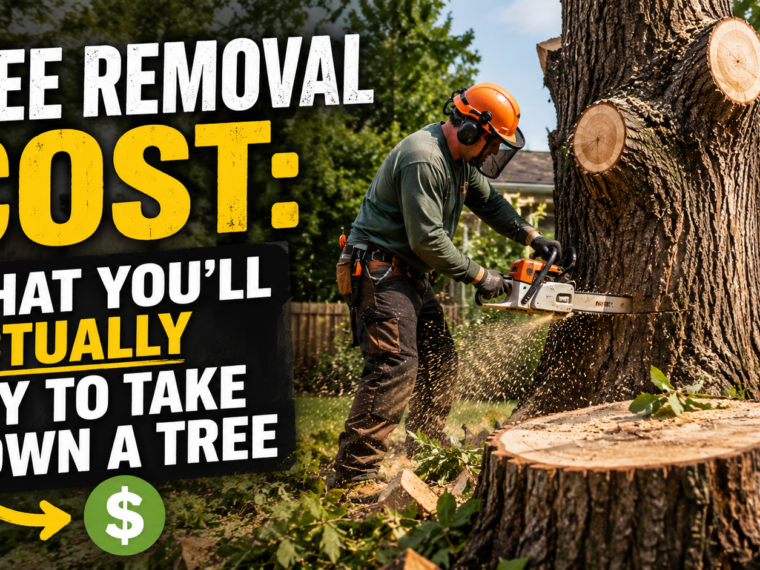
The quote landed in my inbox and I read it twice: $1,850 to take down one leaning maple in the backyard. My neighbor got the same tree species removed for $600. Same town, same summer. So what gives? Tree removal cost is one of those home-service numbers that seems to be pulled out of thin air — until you understand the handful of factors every arborist is quietly adding up while they walk your yard.
Here’s the good news: once you know what moves the price, you can read a quote like a pro, spot the padding, and know exactly when a job is worth paying for versus when you can handle it with a Saturday and a good saw.
What Tree Removal Actually Costs in 2026
Most homeowners in the U.S. pay somewhere between $400 and $2,000 to remove a single tree, with the national middle sitting around $750 to $1,200. But that range is almost useless on its own, because a “tree” can mean a 15-foot dogwood or a 70-foot oak hanging over your roofline. Those are completely different jobs.
A rough way to think about it, sorted by height:
- Small trees (up to 30 ft) — think crape myrtle, dogwood, small ornamentals: $150–$500
- Medium trees (30–60 ft) — maples, birches, many fruit trees: $500–$1,200
- Large trees (60–80 ft) — mature oaks, pines, ash: $1,000–$2,000
- Very large trees (80 ft+) — old-growth hardwoods, tall conifers: $2,000–$4,000+
Height gets the headline, but it’s rarely the thing that blows up a quote. The real cost driver is almost always risk — and that’s where the walk-around matters.
The Five Things That Move a Tree Removal Quote
When an arborist gives you a wildly different number than you expected, it’s usually one of these five factors doing the heavy lifting.
1. Location and access. A tree standing alone in an open field is a dream job — they can drop the whole thing in one piece. A tree wedged between your house, a fence, and the power line has to come down in small, roped sections, one careful piece at a time. That single difference can double or triple the price.
2. Health and condition. This one surprises people: a dead tree often costs more to remove than a healthy one, not less. Dead and rotting wood is unpredictable and dangerous to climb, so crews move slower and charge for the added risk. If you’re not sure whether a tree is dying or just stressed, it’s worth knowing the warning signs of termite damage too — infested trees near a house are a removal priority for reasons beyond the tree itself.
3. Trunk diameter. Two trees can be the same height but one has a trunk twice as thick. More wood means more cutting, more hauling, and more time. Diameter matters as much as height.
4. Species. Hardwoods like oak and maple are dense and heavy — slower work than a soft, fast-cutting pine of the same size.
5. Emergency vs. scheduled. A tree that just came down on your shed at 9 p.m. in a storm will cost far more than the same tree removed on a calm Tuesday you booked three weeks out.
The Costs That Don’t Show Up in the Headline Number
Real talk: the number that stings isn’t usually the removal — it’s the extras that get quoted separately, or worse, sprung on you afterward. Ask about every one of these before you sign anything.
- Stump removal or grinding. Taking the tree down does not include the stump. Grinding a stump typically runs $75–$400 on its own, depending on size. If you want the roots dug out entirely, it’s more.
- Debris hauling. Some crews haul away every branch and log; others leave a mountain of wood in your driveway unless you pay extra. Confirm what “cleanup” includes.
- Log splitting or chipping. Want the wood turned into mulch or firewood? That’s often an add-on.
- Permits. Many cities require a permit to remove trees above a certain size, or protect specific species entirely. Fees vary, but the fine for skipping one can dwarf the removal cost.
- Travel or crane fees. Rural properties or trees that need a crane to lift sections over a house carry surcharges.
A quote that looks cheap but excludes the stump and hauling can end up more expensive than the “pricey” one that includes everything. Compare the total, not the top line. Our landscaping cost guide covers how to get any outdoor quote itemized properly.
When You Can Skip the Pro (and When You Absolutely Shouldn’t)
I’m all for saving money, and some small tree jobs are genuinely DIY-friendly. If a tree is under about 15 feet, well clear of any structure, power line, or fence, and you’re comfortable with a chainsaw, you can likely handle it yourself for the cost of renting equipment — usually $50–$150 for a day.
But here’s where I’ll be the friend who tells you the hard truth: the moment a tree is tall, leaning toward anything you’d hate to lose, near a power line, or dead and brittle, put the saw down and call a licensed, insured arborist. Tree work is consistently one of the most dangerous DIY tasks people attempt. A professional carries insurance precisely because things go sideways — and if an uninsured tree lands on your neighbor’s roof, that bill is now yours.
How to Get a Fair Price
The single best money-saving move is boring but reliable: get three written quotes. Prices for the exact same tree can swing by hundreds of dollars between companies, and having competing bids gives you real leverage.
A few more ways to keep the tree removal cost honest:
- Book in the off-season. Late fall and winter are slow for tree crews. Many will discount just to keep their teams working.
- Bundle jobs. Removing two or three trees at once, or adding a trim to a removal, usually earns a better per-tree rate than separate visits.
- Always verify insurance. Ask for proof of liability and workers’ comp coverage in writing. A company that hesitates is telling you something.
- Keep the wood. Ask them to leave logs cut to firewood length instead of hauling them off — you save the hauling fee and get free firewood, which pairs nicely if you’ve got a fire pit.
What to Do With the Space Afterwards
One thing people rarely plan for: taking down a mature tree completely changes the light in that part of the yard. A bed that thrived in deep shade for twenty years will suddenly be baking in full sun, and grass that never established may finally take. Before you replant, it’s worth reading up on what grows well in shade versus what needs sun, so you’re not replacing plants twice.
Removing a tree also tends to expose the front of the house in a way that’s either an improvement or a problem — it’s worth a look at the curb appeal upgrades that add the most home value before you decide what fills the gap.
If there’s one thing to take away, it’s this: never accept a quote until you’ve walked the tree with the arborist and asked them to point out exactly what makes it easy or hard. The good ones will happily show you — the leaning trunk, the tight gap by the garage, the power line overhead. That five-minute conversation is what separates the homeowner who overpays by a thousand dollars from the one who gets a fair deal and a clean yard. Ask the questions, get it in writing, and let the number make sense before you ever say yes.