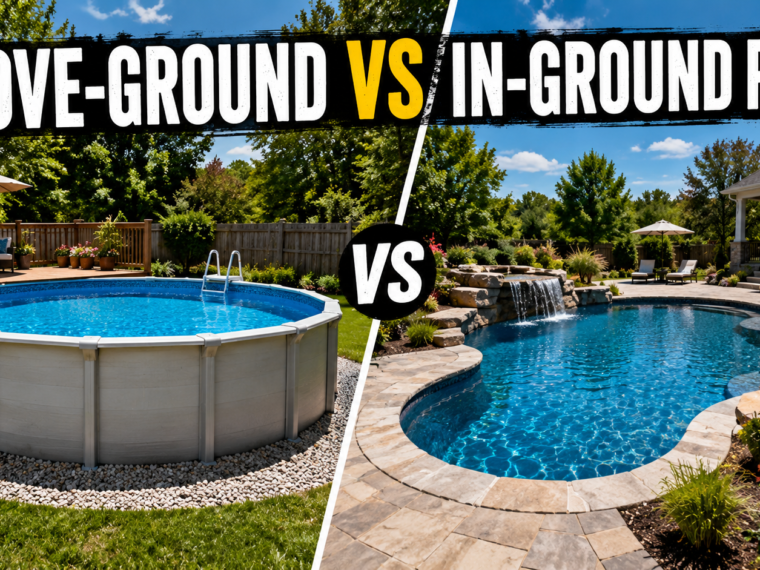
Here’s a number that stops most people cold: the same backyard pool can cost you $3,000 or $80,000 depending on one decision you make before you ever fill it with water. That decision — above-ground or in-ground — shapes your budget, your yard, your resale value, and honestly, how much you’ll actually enjoy summer. And most homeowners pick based on a gut feeling instead of the real math.
So let’s do the real math. If you’re weighing a pool this year, this is the honest breakdown of what each type actually costs, what nobody tells you about the “extras,” and how to figure out which one fits your yard and your life. By the end you’ll know exactly which side of the fence you’re on.
The Big Picture: In-Ground Pool Cost vs. Above-Ground
Let’s put the headline numbers side by side, because the gap is enormous and it drives everything else.
- Above-ground pool: roughly $1,500 to $6,000 for the pool itself, or $3,000 to $12,000 fully installed with a deck and setup.
- In-ground pool: roughly $35,000 to $65,000 for a standard build, and $80,000+ once you add premium features, landscaping, and a fence.
That’s not a small difference — an in-ground pool can cost ten times what an above-ground one does. But price alone is a trap. A cheap pool you barely use is expensive. A pricier pool that becomes the center of family life for fifteen years can be worth every dollar. The real question is what you get for the money.
What Drives In-Ground Pool Cost
In-ground pools are basically a construction project, and the price swings hard based on the material you choose:
- Vinyl liner: the most affordable in-ground option, around $35,000 to $55,000. The liner needs replacing every 7 to 10 years (budget $3,000 to $5,000 when it does).
- Fiberglass: a pre-molded shell dropped into the ground, usually $45,000 to $70,000. Fast to install and low-maintenance, but you’re limited to the shapes the manufacturer makes.
- Concrete (gunite): the premium, fully custom route at $60,000 to $100,000+. Any shape you want, built to last decades, but the slowest and priciest to build and resurface.
Then come the costs the sales brochure is quiet about: permits, excavation on a sloped or rocky lot, a required safety fence, electrical work for the pump, water to fill it, and landscaping to fix the yard the diggers tore up. These “extras” routinely add $10,000 to $20,000. Always ask for an all-in quote, not just the pool price.
What Drives Above-Ground Pool Cost
Above-ground pools are far simpler, and the price reflects it:
- The pool kit: $1,500 to $6,000 depending on size, wall material (steel, resin, or aluminum), and quality.
- Installation: $1,000 to $3,000 if you hire it out, or close to nothing if you’re handy and the ground is level.
- A surround deck: optional but popular, adding $2,000 to $6,000 and turning a “kiddie pool” into a real backyard feature.
The maintenance and running costs — pump, chemicals, water, electricity — are lower too, simply because these pools hold less water and less equipment. For a lot of families, that’s the whole appeal: a real pool without a second mortgage.
Beyond Price: The Trade-Offs That Actually Matter
Money is only half the decision. Here’s how they stack up on the things you’ll live with every day.
Lifespan. A well-built in-ground pool lasts 20 to 40 years or more. An above-ground pool typically lasts 7 to 15 years before the walls and liner give out. So the in-ground pool’s higher price is spread over a much longer life.
Home value. This one surprises people. In the right climate — think warm regions where pools are expected — an in-ground pool can add real resale value. An above-ground pool adds little to nothing, and some buyers even see it as something they’ll have to remove. If resale matters, that’s a point for in-ground.
Installation time. An above-ground pool can be swimming-ready in a day or a weekend. An in-ground build is a multi-week (sometimes multi-month) project with permits, inspections, and a torn-up yard in the meantime.
Yard commitment. An in-ground pool is permanent — you’re reshaping your property. An above-ground pool can be taken down and even moved, which is a real plus if you rent, plan to move, or just aren’t sure.
Real Talk: What I’d Tell a Friend
A neighbor of mine agonized over this for two summers. He desperately wanted the glossy in-ground pool from the magazines, but every quote came back north of $70,000 with the fence and landscaping. He finally put in a good-quality above-ground pool with a wraparound deck for about $9,000 — and you know what? His kids are in it every single day, and he sleeps fine at night because he didn’t take out a loan to swim.
That’s the thing nobody says out loud: the “best” pool isn’t the most expensive one. It’s the one you can comfortably afford and will actually use. A pool you resent paying for is never fun, no matter how pretty it looks.
How to Decide: A Simple Gut-Check
Strip away the brochures and it comes down to a few honest questions:
- Lean above-ground if you want a pool this summer, you’re watching the budget, you might move in a few years, or you’re just testing whether your family will really use one.
- Lean in-ground if you’re staying put long-term, you live in a warm-climate area where pools boost resale, and you can cover the full all-in cost — not just the pool — without straining.
The One Move That Saves the Most Money
If you take just one thing from all of this, take this: get at least three all-in, itemized quotes before you sign anything — and make each contractor include permits, fencing, electrical, water, and yard restoration in writing. The single biggest way people overpay for a pool isn’t choosing in-ground over above-ground; it’s accepting a lowball “pool-only” price and getting hammered by $15,000 of “surprise” extras once the digging starts.
Do that homework up front, match the pool to the yard and budget you actually have, and you’ll spend your summer floating on the water instead of drowning in regret. That’s a pool worth having.