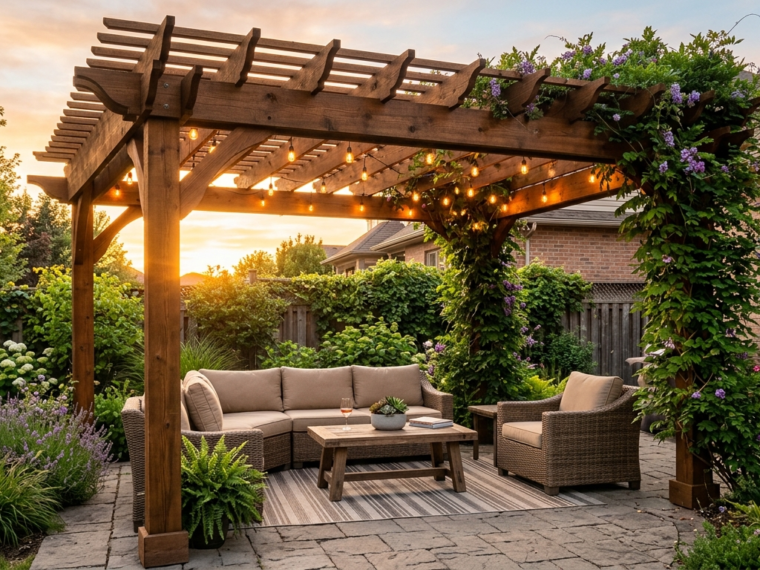
I priced out a pergola for my own patio last spring and got three numbers that couldn’t have been further apart: $600, $4,200, and $11,000 — for what was, on paper, the “same” 12×12 structure. That gap isn’t a scam or a fluke. It’s the difference between a kit, a semi-custom build, and a fully custom one, and almost nobody explains which one actually makes sense for a given yard before you’ve already committed a deposit.
If you’re weighing a pergola for shade, curb appeal, or just somewhere nice to sit with your coffee, here’s the real breakdown of what you’ll pay, where the money actually goes, and which option is worth it for your situation.
What Drives the Price of a Pergola
Before comparing kits to custom builds, it helps to know what you’re actually paying for. Four things move the number more than anything else:
- Material — pressure-treated pine is the budget option, cedar and redwood cost more but resist rot naturally, and aluminum or vinyl cost the most upfront but need almost no maintenance.
- Size and height — most pergolas are priced per square foot, and taller posts (for clearance over a hot tub or outdoor kitchen) mean more material and more labor.
- Roof style — an open-lattice top is the cheapest; louvered or retractable-canopy tops can double the price of the structure alone.
- Site prep — if your patio isn’t already level and your soil needs footings dug below the frost line, that’s often the cost nobody budgets for.
That last one catches people off guard the most. A pergola itself might be affordable — it’s the concrete footings, the electrician for built-in lighting, or the deck it needs to sit on that quietly doubles the bill.
Pergola Kits: The Budget-Friendly Starting Point
A pergola kit ships pre-cut and pre-drilled, so you’re essentially assembling flat-pack furniture at yard scale. For a straightforward 10×10 to 12×14 kit, expect:
- Wood kits: roughly $600–$2,500, depending on cedar vs. pressure-treated pine.
- Aluminum or vinyl kits: roughly $1,500–$5,000, reflecting the lower maintenance and longer lifespan.
- Installation (if you hire it out): add $500–$1,500 for a two-person crew to assemble and anchor it in a day or two.
Kits are genuinely a smart move if your yard is already flat, you don’t need electrical or plumbing run to the structure, and you’re not trying to match an odd-shaped patio. The trade-off is flexibility — a kit is built to standard dimensions, so if your space is 11 feet 3 inches instead of 12 feet, you’ll be trimming, shimming, or picking a slightly awkward fit.
Custom-Built Pergolas: When It’s Worth the Premium
A custom build starts with a contractor designing around your exact space, which is where that $4,000–$11,000+ range comes from. You’re paying for a few things a kit can’t offer:
- Structural engineering suited to your local snow load or wind zone (this matters more than people think if you’re near the coast or in a heavy-snow region).
- Integrated features — recessed lighting, ceiling fans, retractable shade canopies, or a roofline that ties into your house’s existing gutters.
- Non-standard dimensions or shapes, like an L-shaped pergola wrapping a corner of the patio.
- Premium materials, such as steel-reinforced beams or a fully louvered adjustable roof that can close during rain.
Here’s the part worth sitting with: a custom pergola isn’t just a bigger kit. Once you add electrical, a poured footing to code, and a roofline that has to tie cleanly into your house, you’re closer to a small home addition than a weekend project — which is exactly why the price triples.
So, Kit or Custom? A Quick Gut Check
Ask yourself these before you call anyone for a quote:
- Is your patio already a standard rectangular shape and roughly level? A kit will likely fit fine.
- Do you want lighting, fans, or a rain-ready roof built in? That pushes you toward custom, since retrofitting those into a kit later is messier and pricier than building them in from day one.
- Are you in a region with real snow load or high wind? Get at least one custom quote with engineering included, even if you end up going with a kit — it’s worth knowing what “built to code” actually costs in your area.
- Is this a “want it now” project or a “want it right” project? Kits can go up in a weekend. Custom builds typically run 3–6 weeks from design to finished structure once permits are pulled.
Permits — the Step People Skip and Regret
Most municipalities require a permit for any freestanding structure attached to the house or over a certain height, and pergolas often fall into that category even though they feel “open air.” Skipping this step is the single most common regret homeowners mention after the fact — not because inspectors show up unannounced, but because it becomes a real problem at resale, when an unpermitted structure can hold up closing or force a retroactive inspection. A quick call to your local building department before you buy anything costs nothing and saves a genuine headache later.
The Real Answer
If you take one thing from this pergola cost guide, let it be this: price the site work and permits before you fall in love with a specific kit or design. The structure itself is rarely what blows the budget — it’s everything underneath and around it. Get a firm number on footings, any electrical, and your local permit requirements first, and you’ll know almost immediately whether a $900 kit or a $9,000 custom build is the one that actually fits your yard, your climate, and what you’re really trying to build out there.