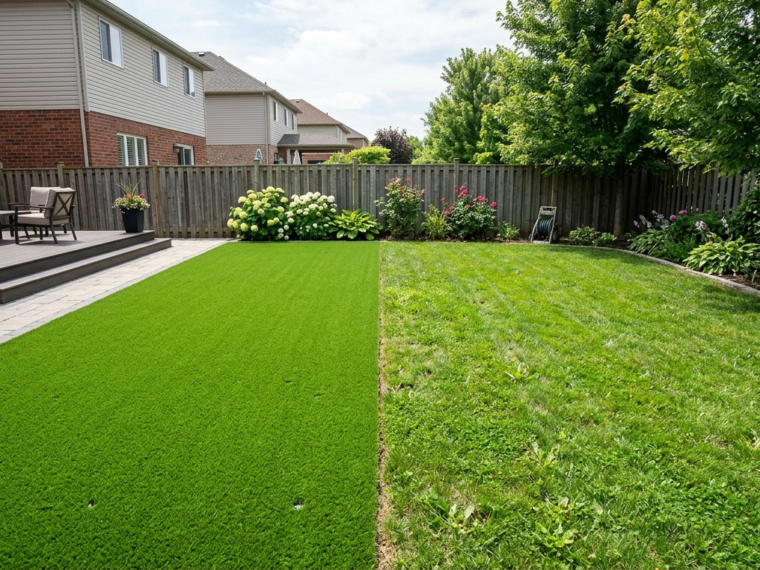
Here’s a number that surprises most homeowners: professionally installed artificial grass runs $9 to $20 per square foot, which means turfing a modest 500-square-foot yard can cost more than $7,000 upfront. That’s often ten times what it costs to seed a real lawn. So why are so many people making the switch anyway? Because the upfront price is only half the story — and when you run the numbers over ten years, the “expensive” option and the “cheap” option often trade places. Let’s break down the real artificial grass cost versus a living lawn, so you can figure out which one actually wins for your yard.
What Artificial Grass Really Costs
The price tag on synthetic turf has three main parts, and skipping any of them is how people end up with a lumpy, fake-looking mess.
- Materials: Quality turf runs $2 to $8 per square foot depending on pile height, blade shape, and density. The cheap stuff looks like a putting green from a mini-golf course; the good stuff fools your neighbors.
- Base preparation: This is the part nobody budgets for. Installers excavate 3 to 4 inches of soil, lay crushed rock, compact it, and add a weed barrier. Base prep can account for a third of the total bill.
- Installation labor: Seaming, stretching, securing edges, and brushing in infill. Professional installation typically adds $4 to $8 per square foot.
All in, most homeowners pay between $4,500 and $10,000 for an average-sized front or back yard. DIY installation can cut that roughly in half, but base prep is physically brutal work, and a poorly prepped base is the number one reason turf fails early.
The good news: once it’s down, the spending mostly stops. No water, no fertilizer, no mowing. Maintenance is an occasional rinse and a brush-up of the fibers, and quality turf carries warranties of 10 to 15 years.
What a Real Lawn Really Costs (It’s More Than You Think)
A living lawn looks cheap on day one. Seeding costs pennies per square foot, and even professionally installed sod usually lands between $1 and $2 per square foot. For that same 500-square-foot yard, you might spend $500 to $1,000 to get grass established.
But a real lawn is a subscription, not a one-time purchase. Here’s what the ongoing bill looks like for a typical yard:
- Water: Lawns are thirsty. In dry climates, irrigation can add $30 to $100 a month to a water bill during the growing season.
- Mowing: A lawn service typically charges $30 to $65 per visit. Mow it yourself and you’re still buying a mower, fuel, and blade sharpening — plus giving up your Saturday mornings.
- Feeding and treatment: Fertilizer, weed control, aeration, and overseeding commonly add a few hundred dollars a year, whether you DIY or hire it out.
Add it up and a maintained natural lawn often costs $500 to $1,500 per year to keep green. Over a decade, that modest lawn can quietly cost more than the artificial one — especially in hot, dry regions where water is expensive.
The 10-Year Math: Where the Lines Cross
Here’s a simplified comparison for a 500-square-foot yard:
- Artificial grass: roughly $7,000 installed, plus minimal upkeep — call it $7,500 over ten years.
- Real lawn: roughly $750 to establish, plus $800 a year in water and care — around $8,750 over ten years.
In mild, rainy climates where the lawn mostly waters itself, real grass stays cheaper. In the Southwest and other drought-prone areas, artificial turf frequently pays for itself in 5 to 8 years. Some water districts have even offered rebates for replacing thirsty lawns, which shortens the payback further — it’s worth checking what’s available in your area before you commit.
Real talk from my own experience: the mistake I see most often isn’t picking the “wrong” option — it’s going cheap on the right one. A friend of mine bought bargain turf online and installed it over barely-raked dirt to save money. Two summers later it had wrinkles like an unmade bed, and fixing it cost nearly as much as doing it properly the first time. Whichever route you choose, fund it properly or wait until you can.
Beyond Money: The Trade-Offs That Actually Decide It
For most families, the decision comes down to lifestyle, not spreadsheets.
- Heat: Artificial turf gets hot — surface temperatures can climb far above the air temperature on sunny days, uncomfortable for bare feet and paws. Real grass stays cool.
- Kids and pets: Turf handles heavy traffic without bald patches and cleans up easily, though pet owners should rinse regularly. Real grass is softer and cooler for play but shows wear fast.
- The environment: A living lawn supports soil life, absorbs rainwater, and cools the air around it — but demands water and often chemicals. Turf saves thousands of gallons of water a year but is a plastic product with a limited lifespan.
- Resale: Buyers in dry regions increasingly see turf as an upgrade; in lush regions, many still prefer the real thing. Know your market.
Which One Should You Choose?
Choose artificial grass if you live in a hot or dry climate, pay a lot for water, have a heavily used yard, or simply want your weekends back. Choose a real lawn if rain does most of your watering, you enjoy yard work, or a cool, living green space matters more to you than convenience.
And here’s the tip worth remembering from this whole artificial grass cost breakdown: whichever side you land on, get three written quotes and ask each installer (or landscaper) exactly what base preparation is included. That single question separates the pros from the pretenders — and it’s the difference between a yard that looks great for fifteen years and one you’re redoing in three.