
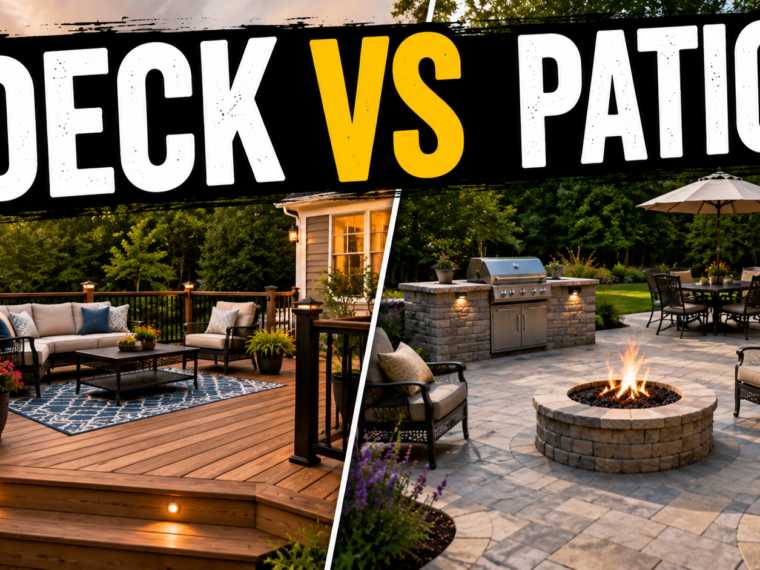
Real estate appraisers will tell you something most homeowners never hear until they’re already holding a contractor’s quote: a deck and a patio almost never return the same amount of money at resale. Same backyard, same square footage, wildly different math. Pick the wrong one for your yard, your climate, or your neighborhood, and you can sink thousands into an “upgrade” that a future buyer barely notices — or worse, quietly discounts.
If you’re standing in your backyard right now trying to decide which one to build, here’s what actually separates them, dollar for dollar.
The Upfront Cost Gap
Before resale value even enters the conversation, the build costs themselves are not close.
- Wood deck: roughly $25–$40 per square foot installed, depending on lumber (pressure-treated pine on the low end, cedar or tropical hardwoods on the high end)
- Composite deck: roughly $35–$60 per square foot — pricier material, but far less upkeep over time
- Concrete patio: roughly $8–$15 per square foot, the cheapest option by a wide margin
- Paver patio: roughly $15–$30 per square foot
- Natural stone patio: roughly $25–$50 per square foot, the premium end of either category
For an average 300-square-foot addition, that’s the difference between a $2,400 concrete slab and a $18,000 hardwood deck. Neither is “wrong” — but they’re not solving the same problem.
What Actually Comes Back at Resale
This is where a lot of homeowners get surprised. National averages (which shift year to year, so always sanity-check against your own market) tend to look something like this:
- Wood deck: recoups roughly 50–65% of cost at resale
- Composite deck: recoups roughly 40–50% — the ROI percentage is lower even though the deck itself often looks better and lasts longer, simply because the upfront cost is so much higher
- Patios (concrete, paver, or stone): recoup roughly 40–60%, with paver and stone patios typically landing on the stronger end because appraisers and buyers read them as a more “finished,” permanent feature
Notice that no option here returns 100% of what you spend. That’s normal for almost every home improvement — the real win is livability now plus a partial credit later, not a guaranteed profit.
It’s Not Really About the Money — It’s About the Yard
Here’s the part cost calculators leave out: the right choice usually isn’t decided by price at all. It’s decided by your actual yard.
- Sloped, uneven, or elevated yards almost always favor a deck. Building a patio on a slope means expensive grading, retaining walls, or drainage work before you even lay the first paver — costs that erase whatever savings concrete promised.
- Flat, ground-level yards usually favor a patio. There’s no engineering problem to solve, so you get more usable space per dollar.
- Wet or humid climates tend to be kinder to composite decking and pavers (both shrug off moisture) and harder on wood decks and unsealed concrete, which crack, warp, or grow moss faster than owners expect.
- Hot, dry climates are patio territory — stone and pavers stay structurally stable and don’t need the yearly sealing that humid regions demand.
Real talk: I’ve watched a homeowner spend nearly $20,000 on a beautiful hardwood deck on a yard that was almost perfectly flat — a patio would’ve given them the same entertaining space for a third of the price, with less upkeep. The deck looked amazing. It just wasn’t solving a problem the yard actually had.
The Maintenance Bill Nobody Budgets For
Resale value is only half the equation — what you pay every year you don’t sell matters just as much.
- Wood decks need restaining or resealing roughly every 2–3 years, plus regular checks for rot, loose boards, and popped nails.
- Composite decks need occasional washing but essentially no staining or sealing — the higher upfront cost buys you two decades of lower-effort ownership.
- Concrete patios are low-maintenance but will eventually crack, especially in freeze-thaw climates, and look tired without periodic resealing.
- Paver and stone patios need occasional weed control between joints and re-sanding every few years, but individual damaged pavers can be swapped without redoing the whole surface — a repair advantage decks and poured concrete don’t have.
When a Deck Wins, When a Patio Wins
If you want the short version:
- Choose a deck if your yard slopes, sits above grade, or you want elevation for a view; if you’re in a wetter climate and want composite’s low upkeep; or if your neighborhood’s comparable homes already lean toward decks.
- Choose a patio if your yard is flat, you want the lowest possible cost per square foot, or you’re in a hot, dry climate where stone and pavers perform well without much fuss.
The Real Move Before You Build
Don’t start with cost calculators — start with two or three local contractor quotes for both options, sized to your actual yard. Costs above are national averages; regional labor and material prices can swing them 20–30% in either direction. Then take fifteen minutes to look at recent sold listings in your neighborhood (any real estate site will show comps) and see what similar homes actually have. If every comparable house on your street has a patio, a deck won’t hurt you — but it’s unlikely to be the reason a buyer pays more, either. Match the improvement to what your yard needs and what your market already expects, and you’ll get the return that’s actually available, instead of the one a glossy brochure promised.