
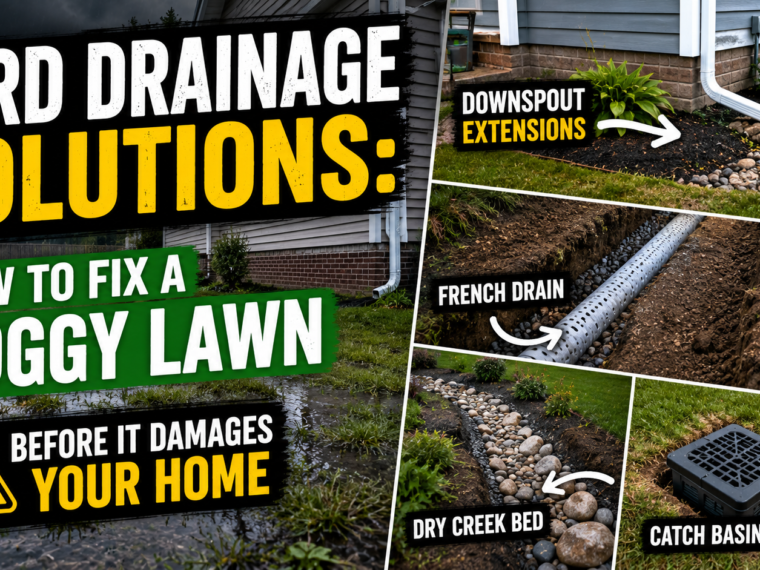
Here’s something most homeowners don’t realize until it’s too late: that squishy spot in your lawn isn’t just annoying — it can quietly cost you thousands. Water that lingers in your yard doesn’t stay in your yard. It drowns grass roots, invites mosquitoes, and worst of all, it slowly works its way toward your foundation. The good news? Most soggy-lawn problems have a fix, and several of the best yard drainage solutions cost far less than people expect. Let’s walk through how to figure out what’s wrong with your yard — and exactly what to do about it.
First, Figure Out Why Your Yard Holds Water
Before you spend a dime, spend twenty minutes after the next good rain just watching your yard. Where does the water come from, and where does it try to go? Nearly every drainage problem traces back to one of these causes:
- Grading that slopes toward the house. Your yard should fall away from the foundation — roughly 6 inches of drop over the first 10 feet. If it doesn’t, water heads straight for your basement or crawl space.
- Compacted or clay-heavy soil. Water can’t soak in, so it sits on the surface for days.
- Downspouts dumping too close to the house. A single downspout can move hundreds of gallons during a storm. If it ends a foot from your wall, that water has nowhere good to go.
- Low spots. Natural dips collect runoff from everything around them.
- Hardscape blocking flow. Patios, walkways, and driveways can act like dams, trapping water on the uphill side. If you’re planning hardscaping work, drainage should be designed in from the start rather than fixed afterwards.
Identifying the cause matters because each one points to a different fix — and picking the wrong solution is the fastest way to waste money on drainage.
The Simple Fixes (Start Here)
A surprising number of soggy yards get fixed with one weekend and less than a hundred dollars. Try these before anything bigger:
- Extend your downspouts. Flexible or buried extensions carry roof water 6 to 10 feet away from the foundation. This is the cheapest, highest-impact drainage fix there is — and if you’re redirecting that water anyway, a rain barrel system lets you capture it for the garden instead of just moving the problem.
- Clean your gutters. Overflowing gutters dump water right at the base of your walls. Twice a year, minimum — or consider whether gutter guards are worth it for your roofline.
- Aerate compacted soil. A core aerator (rentable for an afternoon) pulls plugs out of the lawn so water can actually soak in. Follow up with a thin layer of compost and you’ll improve absorption season after season.
- Fill small low spots. A few bags of topsoil, raked level and reseeded, can erase a minor puddle zone for good.
Real talk for a second: I once watched a neighbor get quoted a serious amount of money for a full drainage system, when the actual problem was two clogged downspouts pouring water into the same corner of his lawn. Twenty minutes on a ladder solved what a contractor wanted four figures to fix. Always rule out the simple stuff first — the honest pros will tell you the same thing.
Bigger Yard Drainage Solutions (When Simple Isn’t Enough)
If water still stands in your yard after the easy fixes, it’s time for one of the heavier-duty options. Here’s what each one does best:
French Drains
The classic fix for water that moves through your yard or collects along a line. A French drain is a gravel-filled trench with a perforated pipe at the bottom that intercepts water and carries it somewhere safe — a street, a dry well, or a lower part of the property. It’s the go-to solution for soggy strips along fences, foundations, and property lines. Expect professional installation to run roughly $25 to $50 per linear foot depending on depth, soil, and where you live, though prices vary widely by region.
Dry Creek Beds
Part drainage, part landscaping feature. A shallow, stone-lined channel guides runoff across your yard while looking like an intentional design choice. If your problem is water flowing through the yard rather than sitting in it, a dry creek bed handles the flow and adds curb appeal at the same time.
Rain Gardens
Instead of fighting the low spot, plant it. A rain garden is a shallow, bowl-shaped bed filled with water-tolerant plants that soaks up runoff within a day or two. It turns your problem area into a pollinator-friendly feature — and it’s one of the most budget-friendly options if you do the digging yourself. We’ve covered how to build a rain garden and what it actually costs in a full step-by-step guide, including the percolation test that tells you whether your site will work.
Regrading
When the slope itself is wrong, no amount of pipe will fully solve it. Regrading reshapes the yard so water naturally flows away from the house. It’s the most involved option and usually a job for a pro with equipment, but it fixes the root cause rather than the symptom. On steeper lots this often goes hand in hand with a retaining wall, so it’s worth pricing both together.
DIY or Call a Pro?
A fair rule of thumb: if the fix involves surface water and hand tools, DIY is realistic. Downspout extensions, small low spots, rain gardens, and even short French drains are all within reach of a motivated homeowner with a shovel and a free weekend.
Call a professional when:
- Water is reaching your foundation, basement, or crawl space
- The yard needs regrading
- You’d be digging near buried utilities (always have lines marked first — it’s a free service in the U.S., just call 811)
- The drainage has to tie into a sump pump, dry well, or municipal system
Foundation water is the one place not to gamble. Repairing a wet basement costs many times more than fixing the drainage that caused it, so if water is getting anywhere near your house, get a qualified drainage contractor to look at it sooner rather than later. Our landscaping cost guide covers how to compare itemized quotes and what a fair deposit schedule looks like.
The One Thing to Do This Week
If you take just one step after reading this, make it this: the next time it rains, grab an umbrella and walk your property while the water is still moving. Photograph where it pools, where it flows, and where your downspouts discharge. That ten-minute walk tells you more than any guide can, and it’s exactly the information a contractor needs if you end up hiring one — which often means a more accurate quote, too. Most yard drainage solutions fail not because the method was wrong, but because nobody watched where the water actually goes. Watch first, then fix. Your lawn — and your foundation — will thank you.