Here’s something that catches a lot of homeowners off guard: the blocks or stone you actually see in a finished retaining wall are rarely the expensive part. You can buy a pallet of interlocking concrete block for a few hundred dollars. What quietly runs the bill up — sometimes to five figures — is everything you don’t see: the gravel base, the drainage pipe behind the wall, the excavation, and, once a wall passes about four feet tall, an engineer’s stamp. Understanding the real retaining wall cost means looking past the pretty face of the wall and at the dirt behind it.
If you’ve got a slope that’s sliding, a garden bed that keeps washing out, or a patio you want to carve into a hillside, a retaining wall is often the fix. But the quotes you’ll get can swing wildly, and it’s tough to know if you’re being fairly charged or gouged. So let’s break down what you’ll actually pay, where the money goes, and how to keep the number sane.
What a Retaining Wall Actually Costs (the honest range)
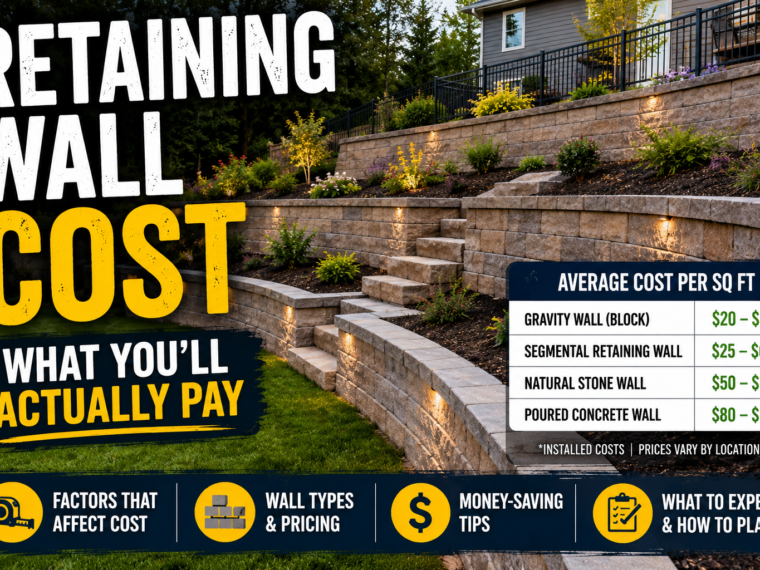
Most contractors price retaining walls by the square foot of wall face — that’s the height times the length of the visible surface. As a general ballpark for an installed wall, you’re looking at roughly $20 to $60 per square foot for a straightforward garden wall, rising to $150 or more per square foot for a tall, engineered structural wall.
To put that in real numbers: a modest 20-foot-long, 3-foot-tall wall (about 60 square feet of face) commonly runs somewhere in the $1,500 to $3,500 zone. Scale that up to a 50-foot wall holding back a real slope, and it’s easy to land between $8,000 and $15,000 once you add engineering and drainage. The spread is huge, and the two biggest levers are what you build it out of and how tall it needs to be.
Retaining Wall Cost by Material
Material choice sets the tone for the whole project. Here’s how the common options generally compare, cheapest to priciest:
- Treated timber — the budget pick, often around $15 to $30 per square foot installed. Fast to build and easy on the wallet, but it’s the shortest-lived option; expect 15 to 20 years before rot sets in.
- Interlocking concrete block — the workhorse, roughly $20 to $50 per square foot. These stackable blocks are engineered to lock together, which is why they’re the most popular DIY-friendly choice for walls under four feet.
- Segmental retaining wall systems — engineered block with geogrid reinforcement, roughly $25 to $60 per square foot. This is what most professional installers use for walls that need real structural capacity.
- Gabion (wire cages filled with rock) — a mid-range, modern-industrial look that drains beautifully, typically $30 to $60 per square foot.
- Natural stone — the premium option at $50 to well over $100 per square foot. Gorgeous and long-lasting, but slow to build and labor-intensive, which is where the cost lives.
- Poured concrete — anywhere from $30 to $150+ per square foot, and that range is not a typo. A short, simple poured garden wall sits near the bottom. A tall structural wall requiring forms, rebar, footings and an engineer’s design sits at the top, and can exceed natural stone. This is the material where “what does it cost” genuinely depends more on the engineering than the concrete.
- Brick — handsome and traditional, generally $30 to $70 per square foot, though it demands skilled masonry.
The takeaway: if budget is your main concern, block or timber gets you there. If you want the wall to be a feature and last a lifetime, stone earns its price — just go in knowing it’s the top of the range. Retaining walls are one of the three core hardscaping elements, alongside patios and walkways, and materials are usually chosen to work together across all three.
The Hidden Costs Nobody Puts in the Headline Quote
This is where budgets quietly blow up. A wall isn’t just a stack of blocks — it’s a system for holding back tons of wet soil, and the parts that make it work are mostly invisible:
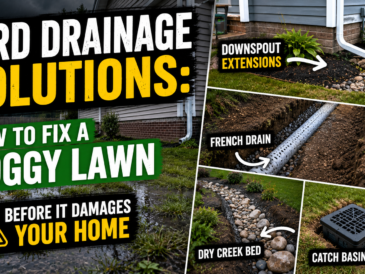
- Drainage — gravel backfill and a perforated drain pipe behind the wall. Skip this and water pressure builds up until the wall bows or fails. It’s not optional, and it’s a real line item. If your yard already has standing water, fix the underlying drainage problem before you build anything against that slope.
- Excavation and grading — digging the trench and hauling away dirt. On a steep or rocky site, this alone can be a big chunk of the bill.
- Base preparation — a compacted gravel footing. A wall built on soft ground is a wall on borrowed time.
- Permits — many towns require one, especially for taller walls, running anywhere from $50 to a few hundred dollars.
- Engineering — here’s the big one. Most building codes require a licensed engineer to design any wall over about four feet tall (sometimes measured including the buried portion). That stamp can add several hundred to a couple thousand dollars, but it’s what keeps the wall standing and keeps you on the right side of code. It’s also the single biggest reason poured concrete quotes vary so wildly.
Real talk: I’ve watched a neighbor try to save money by skipping the drainage gravel on a DIY block wall. It looked perfect for two seasons. Then one soggy spring the whole middle section leaned out like a drunk fence, and he ended up tearing it down and paying a pro to rebuild it properly. The drainage he “saved” on cost him the entire wall. The cheapest retaining wall is the one you only build once.
DIY vs. Hiring a Pro: Where the Line Really Is
A short, decorative garden wall — think one or two feet of stacked block edging a flower bed — is genuinely a doable weekend project if you’re handy. Materials for something like that might run just a few hundred dollars, and the stakes if it settles a little are low.
The line to respect is height and load. Once a wall is holding back a real slope, or climbing past three to four feet, the physics get serious fast. Soil is heavier than people think, and a failing structural wall can damage your foundation, your neighbor’s property, or someone standing near it. That’s the point where the engineering, the permits, and the pro crew stop being upsells and start being the whole reason the wall survives. If the wall is doing a structural job, hire it out — the labor is most of the cost, but it’s buying you a wall that won’t become next year’s emergency.
How to Keep Your Retaining Wall Cost Under Control
You can absolutely trim the number without cutting the corners that matter. A few honest levers:
- Get at least three itemized quotes, and make sure each one spells out drainage and base prep. If a bid is suspiciously cheap, that’s usually what got left out. Our landscaping cost guide walks through how to read an itemized quote line by line.
- Keep the wall under four feet where you can — even splitting one tall wall into two shorter terraced walls can dodge the engineering requirement and often looks better anyway. This is the single largest cost saving available on this entire list.
- Choose a straight run over curves. Every curve and corner adds labor and cut blocks.
- Do the demo or clearing yourself if the site needs it — handing the crew a clean, accessible work area can shave labor hours.
- Buy materials in the off-season. Landscape suppliers often discount block and stone in late fall and winter when demand drops.
The one place I’d never cut is drainage. Everything else on the list is fair game, but the water management behind the wall is the difference between a structure that lasts thirty years and one that leans in three. Nail that, get your quotes itemized, and match the material to the job — that’s how you land a fair retaining wall cost instead of an expensive lesson. Measure your slope, sketch the height and length, and walk into those contractor conversations already knowing the range. You’ll spot a good deal — and a bad one — the moment you hear it.
Worth knowing: a well-built retaining wall doesn’t just solve a slope problem. Structural landscaping is one of the improvements that tends to hold its value, and we’ve looked at whether landscaping really increases your home’s resale value in more detail.
Cost figures are estimates for budgeting and vary significantly by region, wall height, soil conditions and site access. They are not a quote — always obtain written quotes from licensed local contractors. See our Disclaimer.